
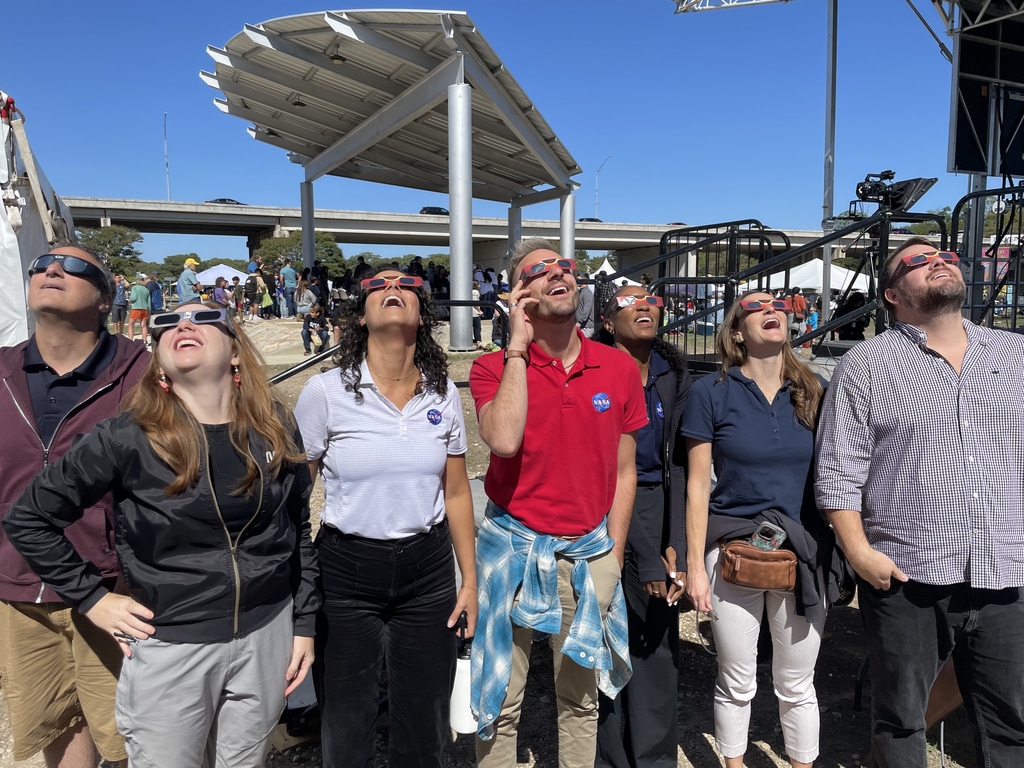
When glasses on, when glasses off: eclipse phases explained for first-time viewers
If you only remember one rule for eclipse day, make it this: glasses on for every bright phase of the Sun; glasses off only during true totality, and only if you are actually inside the path of totality.
That sounds simple, but first-time viewers get tripped up by the words. “Almost total” is not total. A Sun that is 99% covered is still a dangerously bright Sun. An annular eclipse, even at its dramatic peak, is never safe to watch without proper solar protection. And if you’re outside the path of totality, there is no glasses-off moment at all.
The good news is that the sequence is learnable. Once you understand what the eclipse phases look like, the safety rule stops feeling abstract and starts feeling obvious. If you’re planning ahead, it also helps to check whether your viewing spot is actually in the totality path using the Helioclipse Eclipse Explorer / 3D map, and to get ISO 12312-2 certified eclipse glasses before the rush.
The short version: the rule in one breath
Here is the cleanest possible version:
- Partial eclipse phase: glasses on.
- Annular eclipse phase: glasses on the entire time.
- Total eclipse, before totality: glasses on.
- Total eclipse, during totality: glasses may come off only when the Sun’s bright face is completely covered.
- The instant bright sunlight starts to return after totality: glasses back on.
That is the rule supported by NASA and the American Astronomical Society. It applies to direct viewing with your eyes.
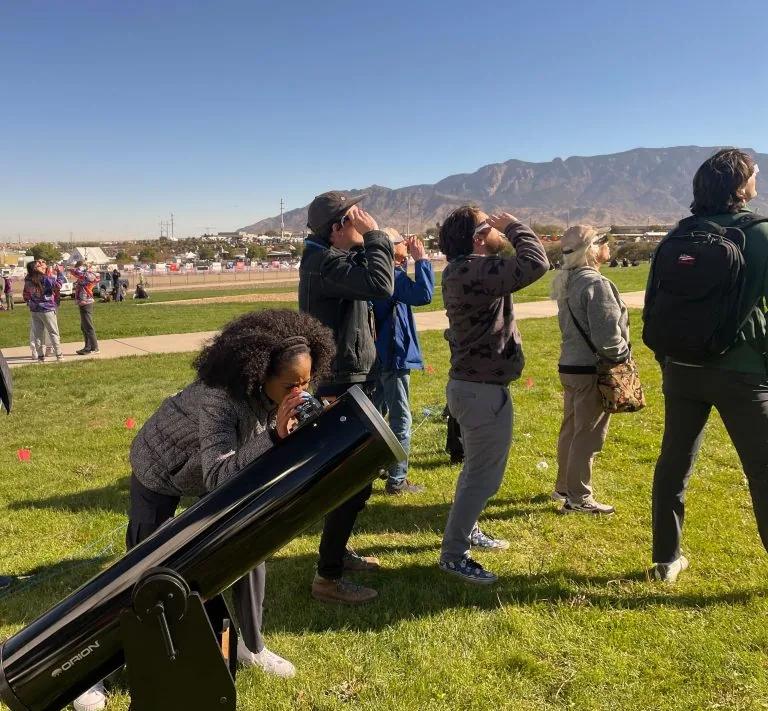
There is one more important layer: optics change the rules. You should never look at the Sun through a camera, binoculars, or a telescope unless that equipment has a proper solar filter mounted securely on the front of the optics. Regular eclipse glasses do not make those devices safe.
Why the phases matter so much
A solar eclipse is not one single visual state. It is a sequence.
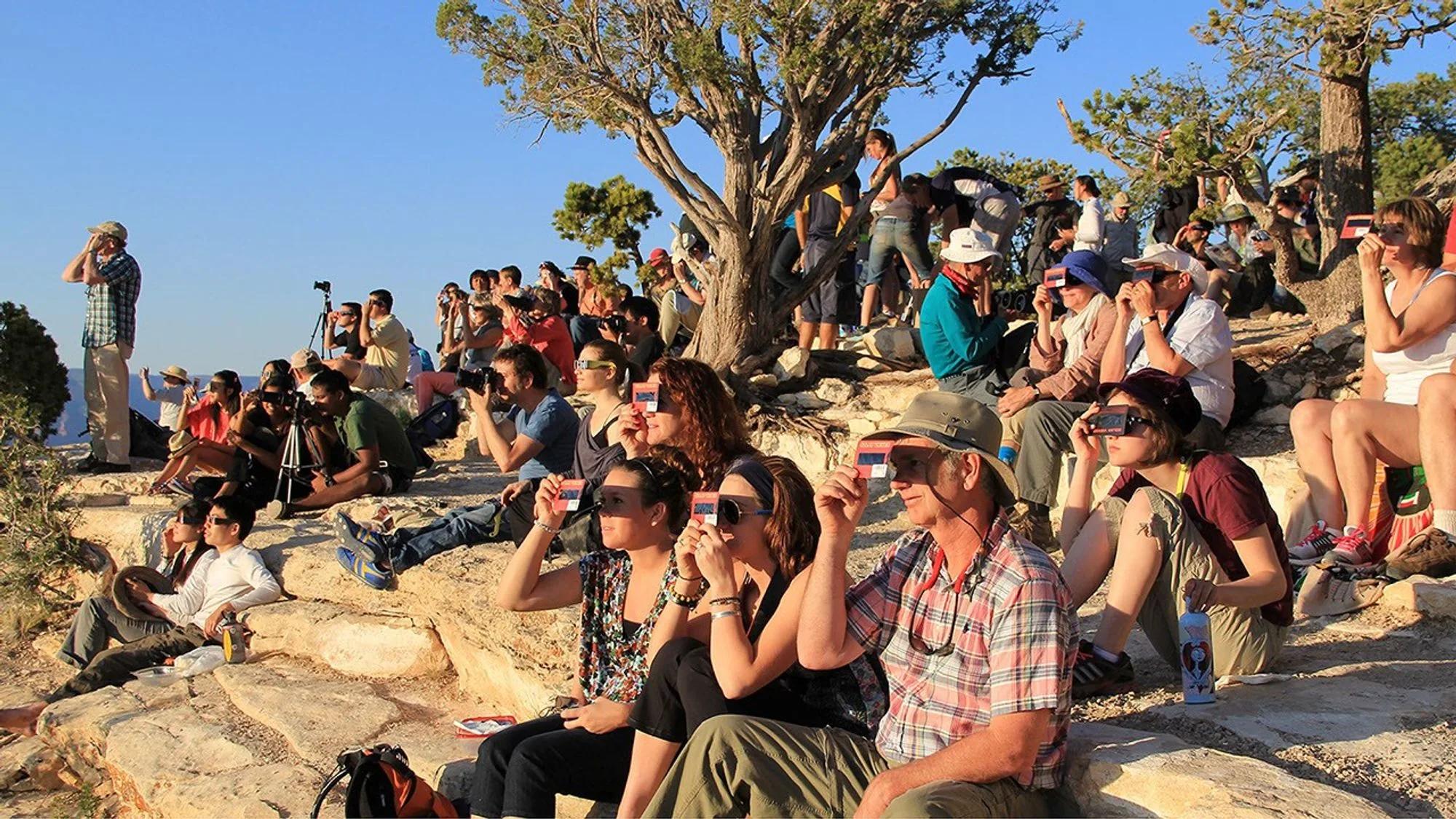
At first, the Moon takes a tiny bite out of the Sun. Then the bite grows. If you are in the right place for a total solar eclipse, the world keeps changing: the light gets stranger, shadows sharpen, the temperature may dip, and the last sliver of direct sunlight collapses into a brilliant point. Then, for a brief interval, the Sun’s bright surface is gone and the corona becomes visible. That brief interval is totality.
Safety hinges on one fact: your eyes are at risk from the bright solar surface, not from the eclipse as an event. During partial phases, even when the Sun looks like a thin crescent, that bright surface is still exposed. During totality, it is not.
This is why the difference between 100% covered and 99% covered is not a tiny technicality. It is the whole game.
First contact to fourth contact: the phase sequence in plain English
If you hear eclipse chasers talk about “contacts,” they mean the key moments when the Moon’s edge lines up with the Sun’s edge in specific ways. You do not need to memorize the jargon, but it helps to know the order.
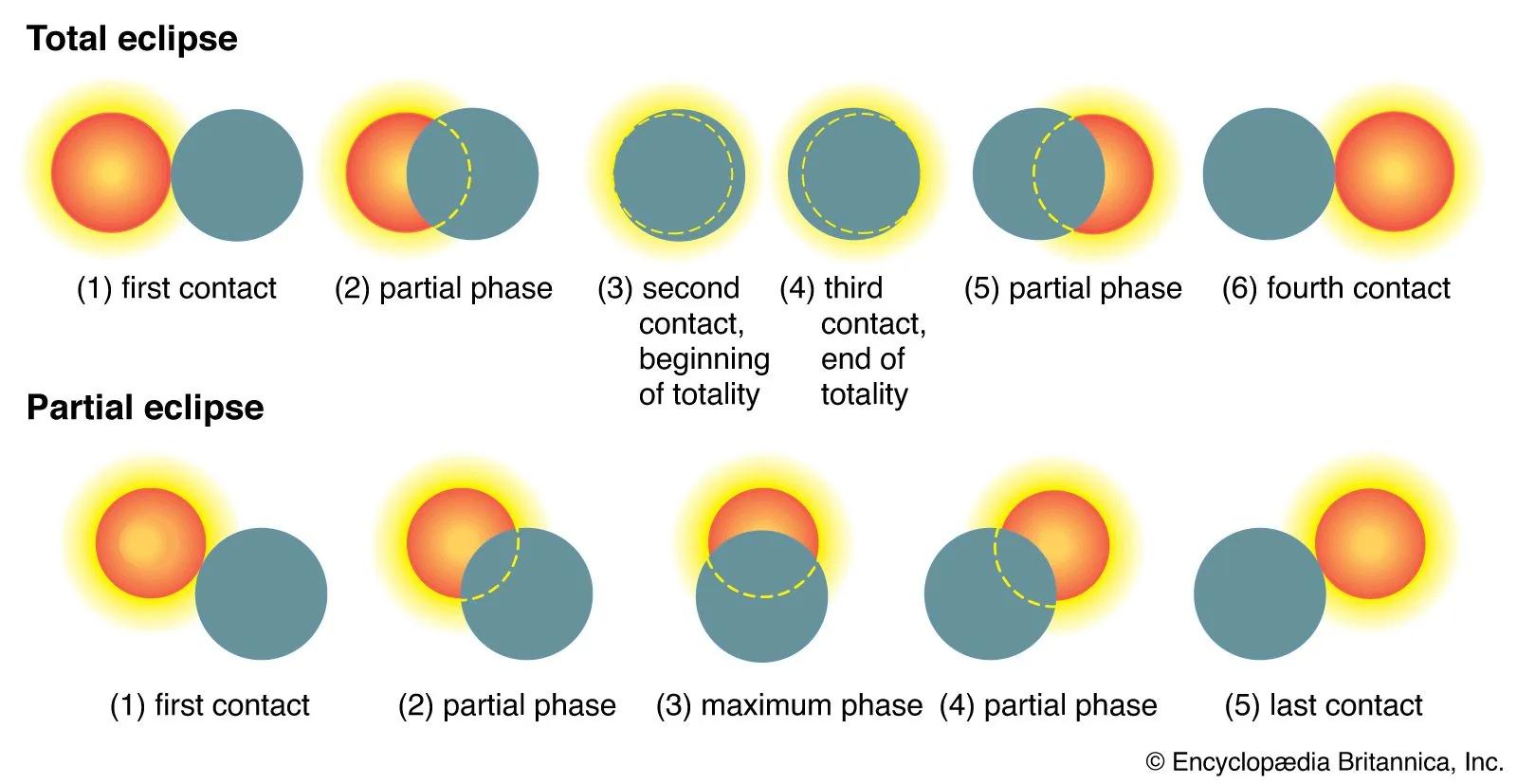
First contact
This is when the Moon first appears to touch the Sun’s disk. The eclipse has begun.
What you see: a small notch appears on the Sun.
Safety: glasses on.
Partial phase before totality
The Moon covers more and more of the Sun. The Sun becomes a shrinking crescent.
What you see: a bite turning into a dramatic crescent. Around you, daylight may still feel surprisingly normal for a while. That catches people off guard. Even with a lot of the Sun covered, the world can remain bright.
Safety: glasses on the whole time.
NASA notes that for many locations in a total eclipse, this partial phase can last roughly 70 to 80 minutes before totality. That long buildup is part of why groups should plan ahead: kids get impatient, people start chatting, and someone always says, “It looks dim enough now, right?” Not yet.
The approach to totality
In the final moments before totality, several famous effects can appear.
- Shadow bands: faint rippling bands of light and dark on the ground or walls.
- Baily’s beads: tiny bright points where sunlight streams through valleys along the Moon’s edge.
- Diamond ring: one last intense bright point of sunlight with the corona beginning to glow around the Moon.
These are spectacular. They are also where people make mistakes.
Safety: keep the glasses on through Baily’s beads and the diamond ring. If any part of the bright Sun is still visible, it is not time yet.
Totality
This is the moment the Moon completely covers the Sun’s bright face.
What you see: the sky darkens dramatically, the corona spreads around the black disk of the Moon, bright planets or stars may appear, and the horizon can look like a 360-degree sunset. This is the part people travel across countries for.
Safety: if you are inside the path of totality and the Sun’s bright face is fully covered, you may remove your eclipse glasses and look directly at totality.
This is the only glasses-off moment in solar eclipse viewing.
Third contact: the end of totality
Totality ends when bright sunlight begins to reappear from behind the Moon.
What you see: a brightening on one edge, then the return of the diamond-ring effect.
Safety: glasses back on before the bright Sun reappears. If you see even a tiny flash of direct sunlight, eye protection needs to be in place.
Final partial phase to fourth contact
After totality, the sequence runs in reverse. The Moon gradually uncovers the Sun until the eclipse ends.
What you see: the crescent Sun grows back toward a full disk.
Safety: glasses on until the eclipse is completely over.
The biggest misunderstanding: “almost total” is still partial
This is the mistake that deserves blunt wording.
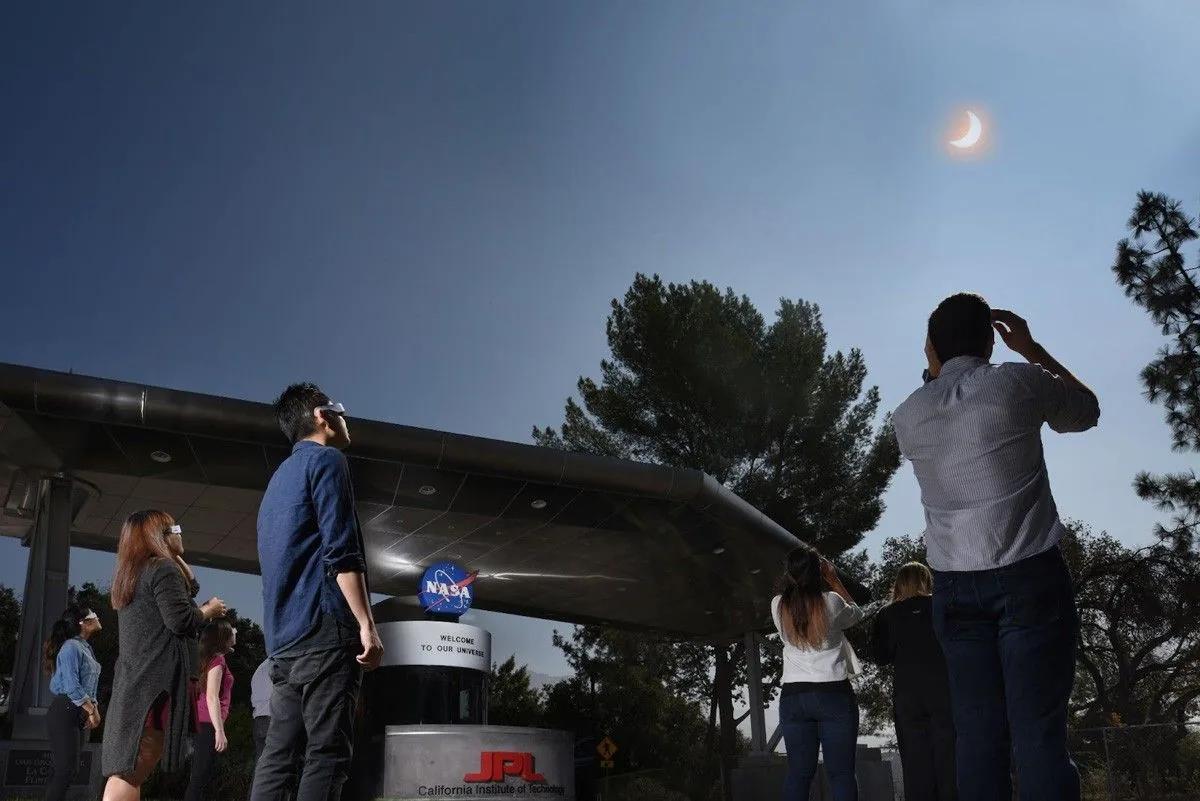
A location with 99% coverage is not “basically total.” It is still a partial eclipse from a safety standpoint. If even a thin arc of the Sun’s bright face remains visible, you need proper solar viewing protection.
That matters because many people plan by city name instead of by eclipse geometry. They hear that a region is “near the path” and assume the experience will be close enough. Visually, it may still be impressive. Emotionally, it may still be memorable. But the safety rule does not bend.
If you want the glasses-off totality experience, you must be inside the path of totality. Not near it. Not just outside it. Inside it.
That is exactly why it helps to verify your spot on the Helioclipse Eclipse Explorer / 3D map. A difference of a few miles or kilometers can change your eclipse from total to partial, which changes both the experience and the eye-safety rules.
Total eclipse vs annular eclipse: same excitement, different safety rule
People often hear “the Moon covers the Sun” and assume the viewing rules are basically the same for every solar eclipse. They are not.
During a total solar eclipse
There is a brief phase when the Moon completely blocks the Sun’s bright face. That is totality. During that short interval only, direct viewing without eclipse glasses is safe.
During an annular solar eclipse
The Moon passes in front of the Sun but appears slightly too small to cover it completely. At maximum eclipse, a bright ring of sunlight remains visible around the Moon.
That ring is not decorative background light. It is direct sunlight.
So the rule is simple: during an annular eclipse, glasses stay on the entire time. There is no safe glasses-off phase.
During a partial solar eclipse
The Moon never fully covers the Sun from your location.
Again: glasses stay on the entire time.
If you are organizing a family watch party, school event, or neighborhood gathering, this is worth saying out loud before eclipse day. People remember the dramatic photos of totality and may assume every eclipse includes that same naked-eye moment. It does not.
How to know when it is actually safe to remove eclipse glasses
For a total solar eclipse, the safest practical cue is this: remove your glasses only when the Sun’s bright face is completely gone.
NASA phrases this clearly: you can look without proper eye protection only during the brief period when the Moon completely obscures the Sun’s bright face. The AAS says the same thing.
In real life, that means:
- not when the Sun is a razor-thin crescent,
- not during Baily’s beads,
- not during the diamond ring,
- only once direct sunlight has fully disappeared.
If you are unsure, wait a beat. Missing one second of the transition is far better than guessing early.
For groups, it helps to appoint one person to keep track of the phase change and call out the switch. That can be especially useful when children, grandparents, and first-time viewers are all watching together and emotions are running high.
And remember the reverse cue too: the moment bright sunlight starts to come back, eye protection goes back on.
What if you are outside the path of totality?
Then the answer is easy, even if it is a little heartbreaking: glasses stay on for the entire eclipse.
You may still see deep coverage. The Sun may become a dramatic crescent. The light around you may feel eerie and subdued. But without totality, there is no safe direct-viewing interval without a proper solar filter.
This is one reason eclipse planning can be so worth it. Moving from outside the path to inside it does not just improve the view a little. It changes the event qualitatively. It changes what the sky does, what your surroundings feel like, and whether there is a brief naked-eye view at all.
If you are still deciding where to watch, use the Helioclipse Eclipse Explorer / 3D map to check whether your intended location is inside or outside totality. That one planning step can prevent the most common first-timer mistake.
Eclipse glasses: what “safe” actually means
“Eclipse glasses” is not a fashion category. It is a safety device category.
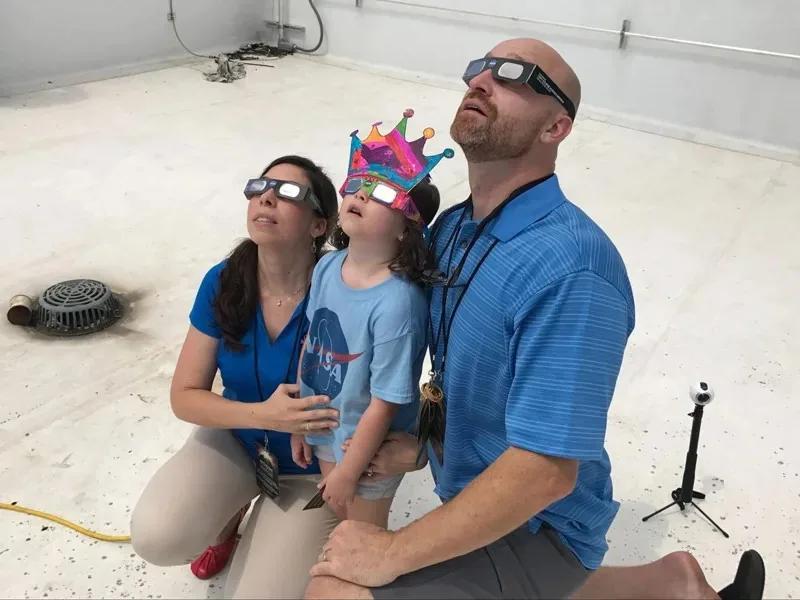
For direct solar viewing, authoritative guidance points to special-purpose solar viewers that conform to the ISO 12312-2 international standard. Regular sunglasses are not remotely enough, no matter how dark they seem.
A few practical rules matter here:
- Inspect your viewers before use. If they are torn, scratched, punctured, or otherwise damaged, do not use them.
- Supervise children. Kids are curious, fast, and not always patient with rules that feel invisible.
- If you wear prescription glasses, keep them on and put eclipse glasses over them, or use a handheld viewer in front.
- Put the viewer on before looking up at the Sun. Look away before removing it.
If you still need viewers, buy early rather than assuming they will be easy to find the week of the event. Demand spikes hard before major eclipses. Helioclipse offers ISO 12312-2 certified eclipse glasses, which is the standard you want to see referenced for direct solar viewing.
The optics warning people underestimate
This is the rule that sounds repetitive until you realize how serious it is:
Do not look at the Sun through a camera, binoculars, or a telescope while wearing eclipse glasses.
Why? Because magnifying optics concentrate sunlight. That concentrated light can damage the glasses filter and your eyes.
If you want to use optics, they need a proper solar filter mounted securely on the front of the instrument. Not at the eyepiece. Not improvised. Not “it came with something dark-looking.” Front-mounted solar filters are a separate setup, and if you are new to them, expert guidance is wise.
The same goes for photography. A phone snapshot of the crowd is one thing. Pointing magnified gear at the Sun is another. If your group has one experienced astronomy person, let that person handle the filtered equipment while everyone else enjoys the eclipse safely with viewers or indirect methods.
If you do not have eclipse glasses, use indirect viewing
No certified viewers? That does not mean you have to skip the eclipse.
For partial phases, indirect viewing is a great option. A pinhole projector works because it projects an image of the Sun onto another surface rather than asking you to look at the Sun directly.
Simple versions include:
- a card with a small hole projecting onto paper,
- a cereal-box projector,
- a colander making many tiny crescent Suns,
- even the gaps between leaves in a tree canopy.
One of the most delightful eclipse-day sights is looking down and seeing the ground filled with little crescent Suns under a leafy tree. It feels like the whole neighborhood has turned into a natural projector.
Important detail: you look at the projection, not through the hole at the Sun.
Indirect viewing is especially good for schools, parks, and family gatherings because many people can enjoy it at once. It also lowers the stress level for anyone who is nervous about using glasses correctly.
A realistic first-timer timeline
If this is your first eclipse, here is the emotional arc many people go through.
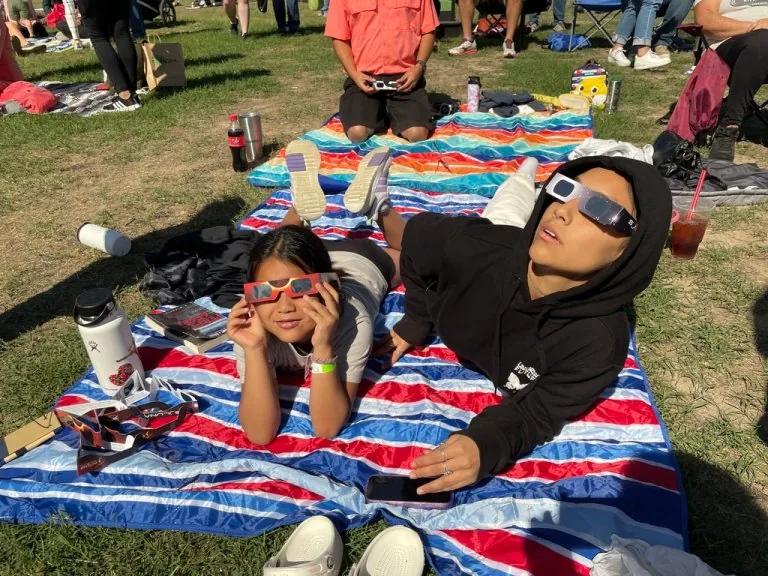
At the start, it feels slow. You glance up through your glasses, see a tiny notch, and think, “Okay, neat.” Ten minutes later, it still feels slow. Then the Sun becomes a more obvious crescent. Shadows start looking odd. The light gets subtly wrong in a way that is hard to describe and impossible to fake.
If you are in the path of totality, the final minutes speed up emotionally even though the celestial mechanics are steady. People get louder, then quieter. Someone notices the temperature drop. Someone else sees shadow bands. Then comes the dangerous temptation to peek early because the world suddenly looks dim.
That is the moment to trust the rule, not your instincts. Human brightness perception is not a reliable safety tool here. The Sun can be mostly covered and still too bright for unprotected viewing.
Then, if you are truly in totality, the bright face vanishes, the corona appears, and the whole event changes character at once. That is your glasses-off moment. Brief. Astonishing. Worth planning for.
And then, just as fast, it ends. The first returning flash of sunlight is your cue to protect your eyes again.
Common mistakes to avoid
Mistake 1: Using regular sunglasses
They are not safe for solar viewing, even very dark ones.
Mistake 2: Assuming “near totality” counts
It does not. Outside the path of totality, glasses stay on throughout.
Mistake 3: Taking glasses off during the diamond ring
The diamond ring is still direct sunlight. Keep them on until the bright face is fully covered.
Mistake 4: Waiting too long after totality ends
As soon as bright sunlight begins to reappear, protection goes back on.
Mistake 5: Looking through binoculars or a camera while wearing eclipse glasses
That is unsafe. Magnifying optics require their own proper front-mounted solar filters.
Mistake 6: Trusting mystery viewers from random sellers
The standard to look for is ISO 12312-2, and the source matters. If the filters are damaged or the product seems questionable, do not gamble with your eyesight.
The family-and-friends version of the rule
If you are the one sending the group text, here is the simplest shareable version:
For any partial or annular eclipse: glasses on the whole time. For a total solar eclipse: glasses on until the Sun is completely covered, glasses off only during totality, glasses back on the instant sunlight returns.
That one message can save a lot of confusion on eclipse day.
It also helps to tell people early what to bring: certified viewers, water, sun protection for skin, and a plan for where they will stand. Eclipses unfold over hours even though the most dramatic part may last only minutes. The more relaxed your setup, the easier it is to enjoy the sky instead of troubleshooting logistics.
For more planning and safety reading, the Helioclipse blog is a good place to keep building your eclipse-day checklist.
On-site next steps
- Get your viewers sorted early: Shop eclipse glasses for ISO 12312-2 certified options.
- Confirm whether your viewing spot is actually in totality: explore the Helioclipse Eclipse Explorer / 3D map.
- Keep learning before eclipse day: browse the Helioclipse blog for more safety and planning guides.
Sources & further reading
Specific articles
- Total Solar Eclipse Safety — NASA’s phase-by-phase safety guidance for total eclipses.
- What to Expect — NASA’s stage-by-stage explainer for first-time total eclipse viewers.
- Eyewear & Handheld Viewers — AAS guidance on eclipse glasses, handheld viewers, and when filters may be removed.
General references
- How to View a Solar Eclipse Safely — core AAS eye-safety reference.
- Eclipse Viewing Safety — NASA’s broader safety hub for total, partial, and annular eclipses.
- How Can You Tell If Your Eclipse Glasses or Handheld Solar Viewers Are Safe? — AAS guidance on vetting viewers and understanding ISO 12312-2.
